AI Integration for JD Edwards 

Why Boss Info Developed Its Own Platform

JD Edwards, Oracle’s ERP system does not offer native AI support out of the box. While Oracle follows a so-called «AI Enablement» philosophy – meaning it provides tools that partners and customers can use to develop their own solutions – it does not offer ready-made AI integrations. «They give you the tools, but you have to build it yourself,» says Krieger. «And everything Oracle offers is tied to the Oracle Cloud. For many of our customers, that’s simply not practical.»

Boss Info has therefore chosen its own path: The result is an open platform that can be flexibly combined with various AI models and different system environments, whether cloud, on-premises, or hybrid.

The Platform: A Custom-Developed MCP Client and Server for JD Edwards

How do you get a language model to communicate with an existing ERP system? Simon Krieger explains it with a simple analogy: «A large language model (LLM) is like a brain. You train it on language, relationships, and knowledge. But without a connection to the limbs, meaning the systems that can actually take action, it remains useless.»

This is exactly where the Model Context Protocol (MCP) comes in. MCP is an open standard that serves as a standardized interface between an AI model and the systems it needs to access. «MCP is essentially the connection between the brain and the limbs,» Krieger explains.

What Does the Solution Look Like for JD Edwards Users?

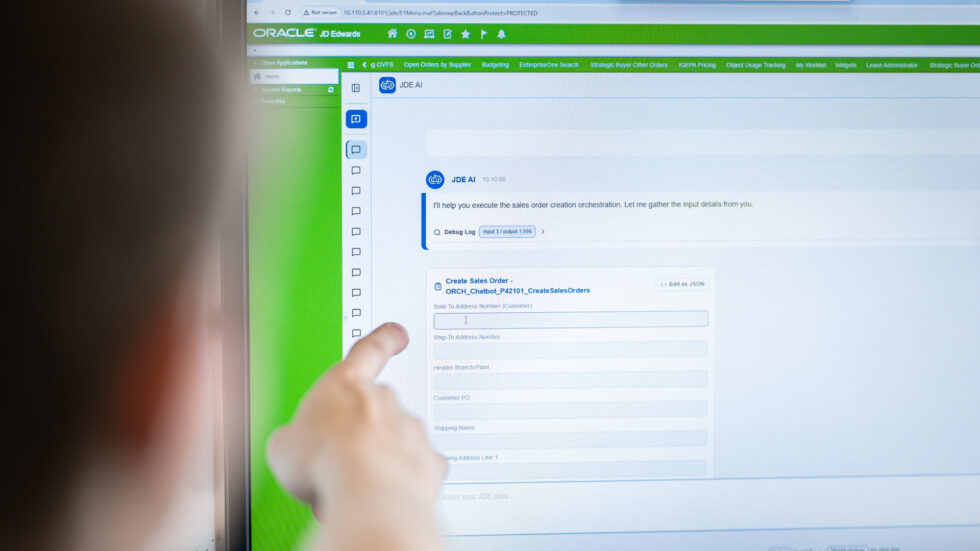
Through a chat interface, users can interact with the ERP system using natural language. Questions such as «What is the item number for this product?» are answered automatically as the AI independently searches the relevant tables in the system and returns the results.

More complex operations, known as orchestrations, allow users to initiate multistep business processes, such as creating a sales order, directly through chat.

Mitarbeiter schreibt mit dem Chat Bot
Mitarbeiter mit Laptop

Simon Krieger Developer, Oracle Business Unit | JD Edwards Team, Boss Info

Simon Krieger has been part of the JD Edwards team at Boss Info for nearly eight years. His career path is unusual: After completing an apprenticeship as a baker/pastry chef (EFZ), he changed careers and began an apprenticeship as an application developer, which he successfully completed in 2021.

Since the merger of Full Speed Systems and Boss Info in 2022, he has been an integral part of the Boss Info team. Today, he develops custom solutions and integrations for Oracle JD Edwards EnterpriseOne, drives the development of AI-based technologies and mentors the next generation of IT professionals at Boss Info’s Sursee location.

Data Security in AI for ERP: Access Rights, Control and Human in the Loop

One of the most sensitive issues when using AI in enterprise systems is data protection. Simon Krieger emphasizes that Boss Info takes a fundamentally different approach to data protection than many other providers: «There are many solutions where the AI has access to everything and then decides what to display based on the user. In my view, that’s the wrong approach, because the AI can be outwitted that way.»

With the Boss Info platform, the opposite is true: Access rights are controlled entirely through the JD Edwards user profile. The AI sees only what the respective user is authorized to see in the System and nothing more. «If an employee does not have access to financial data, then the AI cannot retrieve that data either. Not because we forbid it, but because JD Edwards technically does not allow it.»

Mitarbeiter schreibt am Code

Humans Remain in Control

The AI performs all queries on its own. However, as soon as it changes data – for example, by creating an order or modifying an entry – it requires confirmation from the user. «We don’t want the AI to just act on its own and then have to painstakingly undo everything,» says Krieger. «Humans remain in control.»

Evaluation Framework: How Boss Info Ensures Quality

A well-known risk of using language models is known as hallucination, generating answers that sound plausible but are simply incorrect. How does Boss Info address this?

«You can never rule it out entirely,» Krieger candidly admits. «But we’ve significantly reduced it through prompt engineering. All figures and data output by the AI must be based on real data from the system. The AI is not allowed to make anything up.» In addition, the team has developed an evaluation framework that continuously tests the quality of the model’s responses. Within the chat itself, users can compare the AI’s responses with the actual system data at any time. «If you want to be absolutely sure, you can check it at any time.»

AI Agents in ERP: How Specialized Agents Deliver Better Results

A key architectural principle of the Boss Info platform is its use of AI agents. Rather than relying on a single AI to handle every use case, Boss Info employs four specialized agents, each responsible for a clearly defined set of tasks:

  • General Agent: Answers general JD Edwards questions and explains error messages
  • Data Agent: Performs data queries in the system
  • Orchestration Agent: Controls complex, multi-step business processes
  • App-Report Agent: Helps users find the right application or report in the system

Krieger compares the principle to business management: «If you give one person 20 areas of responsibility, they lose track of everything. The same applies to agents. If you give an agent a clearly defined task, and only that task, it achieves better results.» At the same time, he warns against the opposite: too many agents with overly narrow scopes lead to endless coordination. «The key is finding the right balance.»

The user is unaware of this four-agent architecture. They enter their request directly into the central chat within JD Edwards, and a higher-level router decides in the background which agent will handle the task.

BIF mit Headphones Teams Gespräch mit Roboter

Local vs. Cloud: Data Sovereignty Is Gaining Importance

When it comes to choosing an AI model, Boss Info has observed a clear trend: As soon as customers hear that data will be transferred to a cloud environment, questions arise. «The first reaction is always: Where is my data going?» reports Krieger.

Mitarbeiter vor dem Bildschirm am arbeiten

Boss Info is therefore currently testing the operation of AI models on its own servers. The company is using Qwen 3, a model developed by the Chinese company Alibaba. «Yes, it’s from Alibaba,» Krieger says outright. «But because it’s installed locally, no data leaves the premises. That’s the key point.»

The Boss Info platform is designed to function independently of the model used. Private and public cloud LLMs, on-premises installations, and hybrid setups are all possible. «I see the future in small, specialized models that run on our own servers and are optimized for specific use cases,» Krieger says.

AI in Day-to-Day Business: Practical ERP Use Cases and Where AI Has Its Limits

Not every process is suitable for AI automation. Krieger takes a pragmatic approach: «If a process always follows exactly the same pattern, regardless of the customer or product, there’s no need for AI. Traditional automation is sufficient; for example, for duplicate detection or invoice processing.»

AI delivers real value where exceptions and special cases are the norm, typically in cross-system analysis or when dealing with customer-specific business rules.

icon duplicate

Duplicate Detection
Addresses that have been entered multiple times or with different spellings are automatically detected and corrected.

icon rechnung

Invoice Entry
Incoming invoices are scanned and processed directly in the system.

icon chart network

Cross-System Analyses
Companies with ten or more systems related to ERP can automatically consolidate data from various sources.

icon mensch

Customized Customer Rules
Special requests from individual customers, which otherwise exist only in the minds of experienced employees, can be entered into a database and automatically taken into account by AI.

AI doesn’t replace people – it changes the way they work

Toward the end of the conversation, Krieger addresses a question that causes uncertainty in many companies: Does AI change the work of employees who use the ERP system on a daily basis?

His answer is clear: «Everyone always says that AI replaces people. In my view, that’s wrong. What’s changing are the tasks, not the people. Repetitive, tedious tasks will decrease. In their place, skills such as formulating precise queries, critically evaluating AI outputs, and identifying meaningful applications will take center stage. AI takes over what’s time-consuming and error-prone. Humans remain responsible for making judgments.»

It’s no coincidence that Boss Info doesn’t offer ready-made solutions but instead works with customers to develop use cases. «Every customer needs something different,» says Krieger. «That’s why we created the MCP platform, where we work with the customer to develop exactly what’s needed.»

Interested in our services?

Our experts will be happy to advise you.

Interested in our services?

Our experts will be happy to advise you.

INFOCUS 2026: What Release 26, Redwood and AI mean for JD Edwards customers

What does INFOCUS 2026 mean for JD Edwards customers? Explore the key takeaways on Release 26, Redwood, AI and the future roadmap.

Go to blog article

ERP with Flavor: How bossFood Brought Fresh Momentum to Simperl AG

Simperl AG is modernizing its ERP system with Boss Info, opting for a cloud-based solution that integrates all processes – from mobile order entry to digital document management.

View Case Study

Noventiq accelerates digital transformation with NetSuite and Boss Info

To support its ambitious global growth strategy, Noventiq, a leading provider of digital transformation and cybersecurity solutions, needed a centralised ERP platform that could scale across more than 60 countries.

View Case Study